|
WHEN DESIGNING the city highway in Beograd, the idea
was that it is, in the first place, a busy town traffic road
and all its elements must be subject to town planning and
public services standards. Special attention had to be paid to
the mentioned problems in connection with the section
passing through the urban part of Novi Beograd which is situated on
flat ground. Due to that the roadway was lowered 3 to 4 m below
the base terrain plane, i.e. 2.8 m below the flood flow of the
river Sava.
§ The highway route through the old part of the town required
considerable destruction of residential and other buildings.
§ The basic highway route was designed for the speed of
V=100 km/h. The highway has two one-way carriageways with
three traffic lanes (2x11.5 m), medians of 2 m in the old part
of the town and 3.5 m in Novi Beograd. The carriageways are
bordered with concrete prefabricated elements and are provided
with town-type sewage system.
§ The total length of the sections is 9.5 with seven
grade-separated junctions which connect the city street network
with the highway. According to its importance and complexity
there are two big grade-separated junctions "Mostar" and
"Autokomanda" in the old part of the town. The junction
"Mostar" should especially be mentioned for its complexity because it
was worked out on only 6 ha in 4 building levels with24 collector-distributor roads and 12 bus and 2 tramway routes.
§ About 20% of all town carriageways are built on the
reinforced concrete bridge constructions. The bridges were calculated for
the heaviest loads according to DIN 1072 For the class SJV d0 t. In
the mid part of the highway there is a steel bridge
"Gazela" (author Academician Milan Djuric). 1n the average 47,000 vehicles per
day drive along this road as well as the rapid public town
transport with more than 100,000 passengers daily.
§ The highway complex through Beograd has about 500,000
m2 of carriageway surfaces, out of which 95,000
m2 is on the bridges.
§ To prepare the route for the highway in the old part of the
town, about 1,000 residential units and 136 industrial
buildings had to be pulled down.
§ To build the road bed and remodel the terrain over 2,000,000
m3 of soil material was excavated and transported.
§ In the course of the construction 45 km of water supply and
sewage pipes were laid and over 45 km of electro-power
conduits.
§ For bridges and other reinforced concrete structures 40 km
piles were driven. D In the pavement structures about 240,000 tons of asphalt was
built and about 105 km of pavement curbs placed.
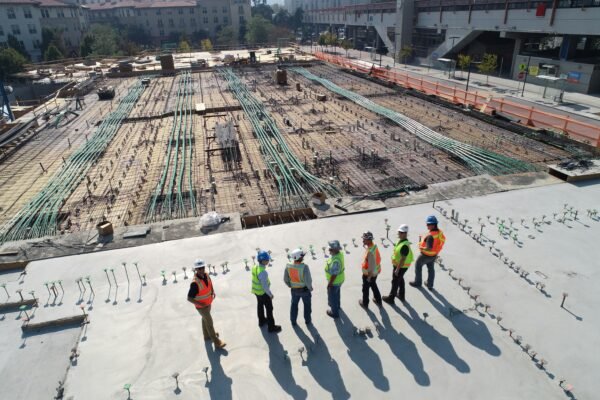
§ More over, it should be pointed out that most of the
construction works were going on under exceptionally complex
conditions due to permanent operation of the city traffic,
constant drainage of underground waters and many other difficult
circumstances. But thanks to the joint efforts of all the
patties concerned, the main works were completed within two years.
|